Why Small Wins Matter
We’ve all heard the saying: “Rome wasn’t built in a day.” But here’s the problem—most of us still try to live like it was. We chase overnight success, quick fixes, and big leaps, but when results don’t come instantly, we give up. The truth is, success is rarely about giant leaps. It’s about the small, consistent steps you take daily that build momentum over time.
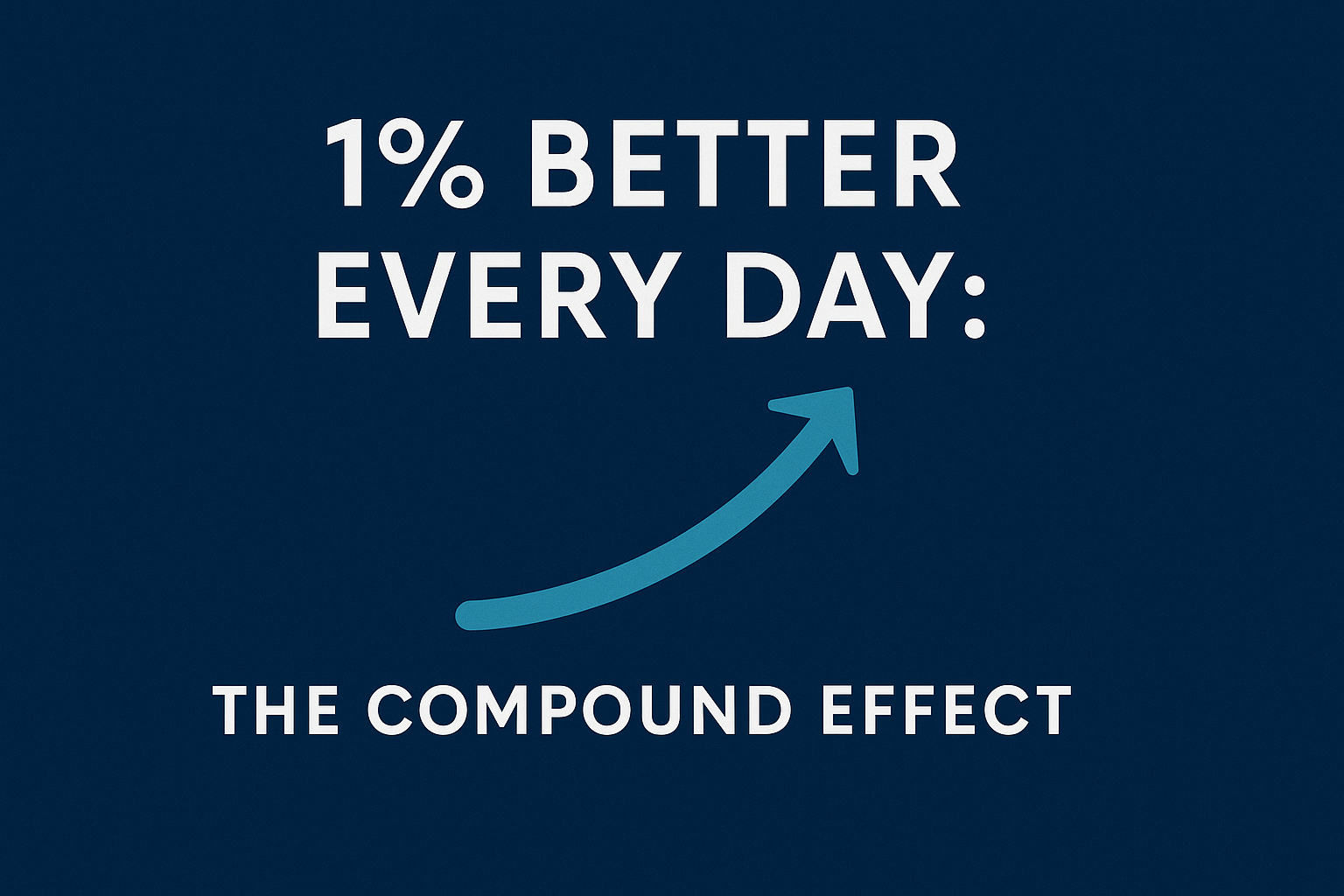
That’s where the compound effect comes in. This principle is simple yet powerful: small, repeated actions add up to massive results if you stick with them long enough. And the best part? You don’t need to overhaul your entire life at once. You just need to get 1% better every day.
What Is the Compound Effect?
At its core, the compound effect is the principle of reaping huge rewards from a series of small, smart choices. Darren Hardy popularized the idea in his book The Compound Effect, but the concept has been around for centuries in fields like finance, athletics, and psychology.
Think of it like this: If you saved a dollar a day, it wouldn’t feel like much. But give it a year with interest, and you’ll notice the difference. Keep it up for ten years, and you’ll see a financial cushion you never thought possible.
The same is true in every area of life:
- A small workout every day builds a strong body.
- Reading a few pages daily sharpens your mind.
- Spending a few minutes networking each week grows your opportunities.
The compound effect doesn’t rely on huge action—it relies on consistency.
The Math Behind 1% Better Every Day
Here’s where things get interesting. If you improve by just 1% every day for a year, mathematically, you won’t just be 365% better. You’ll actually be 37 times better.
That’s because the math follows exponential growth:
- Formula: 1.01^365 ≈ 37.78
- On the flip side, if you get 1% worse each day: 0.99^365 ≈ 0.03
Let that sink in. One path leads to growth that feels almost unbelievable, and the other leads to decline that leaves you almost at zero.
I remember first seeing this formula years ago when I was trying to get healthier. At the time, I wasn’t out of shape, but I also wasn’t at my best. Instead of overhauling my entire diet and exercise plan, I decided to add one push-up per day. On day one, I did 10. By the end of the year, I could crank out 50 with ease. That small decision became the spark that carried into other parts of my health.
The math makes it undeniable: small steps done consistently will always beat one giant leap.
How to Apply the 1% Rule in Daily Life
Health & Fitness
You don’t need a two-hour workout plan to see results. Instead, focus on small upgrades:
- Add one extra rep to your workout each day.
- Swap soda for water at lunch.
- Walk for 10 minutes after dinner.
Over time, these micro-changes transform your body and energy levels.
Career & Skills
Want career advancement? The compound effect shines here:
- Spend 15 minutes a day learning something in your field.
- Read one industry article each morning.
- Reach out to one new person per week to grow your network.
I once had a sales who told me, “If you read 20 minutes a day in your field, in five years you’ll know more than 90% of your peers.” At the time, I thought he was exaggerating. He wasn’t. That consistent learning gave me an edge over people who stopped after college.
Finances
Money is the most obvious place where compounding works:
- Save an extra $5 daily.
- Automate micro-investments through apps like Acorns or Robinhood.
- Pay down debt with small extra payments.
Albert Einstein reportedly called compounding “the eighth wonder of the world.” The earlier and more consistently you start, the more powerful it becomes (Hardy).
Personal Growth & Mindset
Your mindset compounds just like your bank account:
- Journal one thought every night.
- Write down one thing you’re grateful for each morning.
- Spend five minutes meditating daily.
These practices seem small, but over time, they reshape how you see the world.
The Biggest Mistakes People Make with the Compound Effect
- Expecting instant results – We live in a world of instant gratification. If we don’t see results in a week, we assume it’s not working. The compound effect takes patience.
- Quitting too soon – Most people give up just before the tipping point. Imagine digging for gold and stopping one foot short of the treasure. That’s what happens when we quit too early.
- Overcomplicating the process – You don’t need 20 habits at once. Start with one. Master it. Then add another.
Stories That Prove the Compound Effect Works
- Warren Buffett: Nearly all his wealth came after his mid-50s. Why? Because compounding investments need time to snowball.
- Athletes: Think about how professional runners train. They don’t shave off 5 minutes from their time in a week—it’s fractions of a second improved over years that make them champions.
- Personal Story: Early in my career, I committed to learning a little bit more in my field every day. This resulted in getting promoted to higher positions. And leading to more opportunities that others did not have access to.
Building Your 1% Better System
- Track progress – Use journals, apps, or spreadsheets. Tracking builds momentum.
- Start small – Pick one habit that feels almost too easy. The easier it is, the more likely you’ll stick to it.
- Stay accountable – Find a friend, coach, or community to share your progress with. Accountability multiplies consistency.
Conclusion: Small Steps, Big Legacy
The truth is, success doesn’t come from doing extraordinary things once. It comes from doing ordinary things consistently. The compound effect shows us that even the smallest actions, when multiplied over time, can create extraordinary results.
So, here’s the challenge: What’s one 1% action you can take today? It could be one push-up, one page of reading, or one dollar saved. Do it. Then do it again tomorrow. And before long, you’ll look back and realize you’re not just a little better—you’re transformed!
References:
- Hardy, Darren. The Compound Effect. Vanguard Press, 2010.